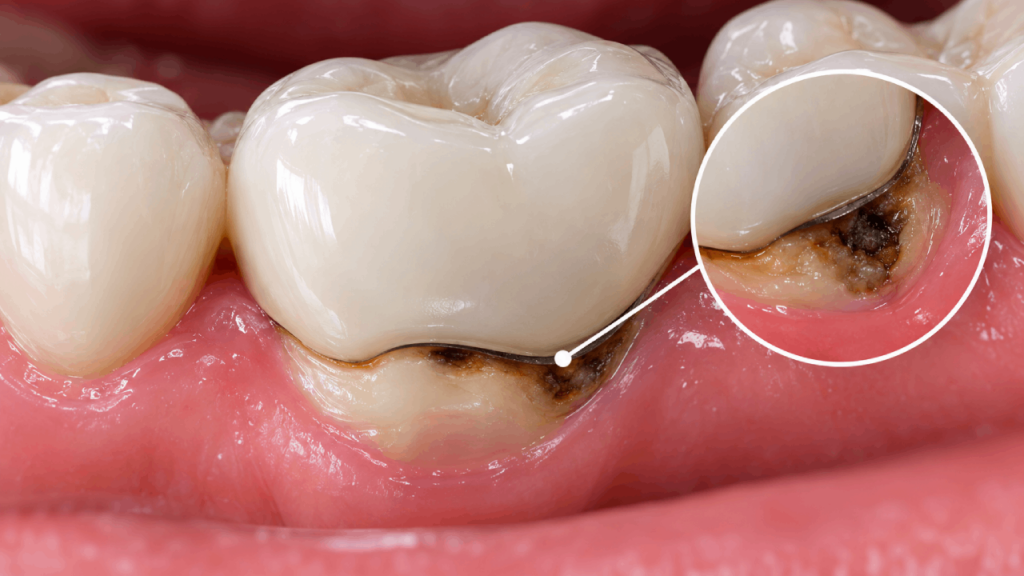
A dental crown protects and restores a damaged tooth, but it does not make the natural tooth underneath completely immune to decay. Tooth decay under a crown can develop, particularly around the edges where the crown meets the natural tooth.
Because much of the tooth is covered, early decay may not always be easy to notice. Paying attention to new sensitivity, discomfort, or changes around a crown—and having regular dental checkups—can help identify problems before more of the tooth structure is affected.
Table of Contents
Can You Get Tooth Decay Under a Crown?
Yes. While the crown itself cannot develop a cavity, the natural tooth underneath and around its margins can still decay.
Decay often begins near the point where the crown meets the tooth. If plaque and bacteria accumulate in this area, acids produced by bacteria can gradually damage the remaining natural tooth structure.
A cavity under a crown may also be difficult to notice in its early stages because the restoration covers much of the tooth. In some cases, the problem is discovered during a routine dental examination before significant symptoms develop.

What Causes Decay Under a Dental Crown?
Several factors can contribute to decay around or beneath a dental crown. Two important factors are plaque buildup around the crown margins and problems affecting the fit or condition of the restoration.
Plaque Buildup Around the Crown Margins
Plaque and food debris can accumulate where the dental crown meets the natural tooth, especially when this area is difficult to clean effectively.
Over time, bacteria within plaque produce acids that can damage the tooth structure and eventually cause decay.
For this reason, caring for a crowned tooth involves more than simply brushing the visible surface of the crown. Cleaning carefully around its margins and between neighboring teeth with floss or another dentist-recommended interdental cleaning method is also important.
A Damaged or Poorly Fitting Crown
Problems with the crown or its margins may create areas where bacteria and food debris can collect and become difficult to remove.
The condition of a crown can also change over time. If it becomes loose, damaged, or uncomfortable, a dental examination can help determine whether there is a problem with the restoration or the tooth underneath it.
However, an older or uncomfortable crown does not automatically mean that decay is present.
What Are the Symptoms of Tooth Decay Under a Crown?
Early decay under a dental crown may cause few or no noticeable symptoms. This is one reason symptoms alone cannot confirm whether a cavity has developed beneath a restoration.
As the problem progresses, however, certain changes may become noticeable.
Tooth Pain or Sensitivity
Some people experience sensitivity to hot, cold, or sweet foods and drinks. There may also be discomfort when chewing or biting on the affected tooth.
Depending on the condition of the tooth, pain may become more persistent as the problem progresses.
However, tooth pain under a crown does not always mean there is decay. Pain can have several possible causes, so the tooth should be examined to determine what is actually causing the symptoms.
Bad Smell or Unusual Taste Around the Crown
A persistent bad smell around a crown or an unusual taste may sometimes occur when plaque or food debris collects around the restoration or when there is a problem with its margins.
These symptoms do not confirm tooth decay on their own. They can also be associated with other dental or gum problems.
Swelling around the crowned tooth, noticeable changes near the crown, or a restoration that feels loose are also reasons to schedule a dental evaluation.
How Is Tooth Decay Under a Crown Diagnosed?
Diagnosis usually begins with a clinical examination of the tooth, crown, surrounding gums, and crown margins. The dentist will also consider any symptoms you have been experiencing.
Dental X-rays may be recommended when appropriate to look for problems that cannot be clearly identified through a visual examination alone.
Detecting decay beneath a crown can sometimes be more challenging than identifying a cavity on an uncovered tooth because the restoration conceals part of the natural tooth structure.
For this reason, a dentist will evaluate the tooth and crown before deciding whether the restoration needs to be removed or replaced. Pain, sensitivity, or odor alone is not enough to make that decision.
How Is Tooth Decay Under a Crown Treated?
Treating decay under a crown depends on several factors, including where the decay is located, how far it has progressed, how much healthy tooth structure remains, and the condition of the existing crown.
There is no single treatment approach that is appropriate for every patient.
Removing the Decay and Restoring the Tooth
Once decay is confirmed, the dentist needs to access the affected area, remove the decayed tooth structure, and evaluate how much healthy tooth remains.
When the damage is limited, it may be possible to treat and restore the tooth while preserving a significant amount of its natural structure.
If decay has reached deeper parts of the tooth, additional dental treatment may be necessary depending on the condition of the pulp and surrounding tissues.
The primary goal is to eliminate the decay and preserve as much healthy tooth structure as possible.
Replacing the Crown When Necessary
A dental crown may need to be replaced if it cannot be preserved during treatment or if its fit, margins, or structure are no longer suitable.
In these situations, the underlying problem is addressed first. The dentist can then determine whether the tooth can be restored and prepared for a new crown.
Finding decay beneath a crown does not automatically mean that every crown must be replaced. The appropriate approach depends on the condition of both the tooth and the restoration.
What Happens If Decay Under a Crown Is Left Untreated?
Untreated decay may continue to damage the natural tooth underneath the crown.
As the cavity becomes larger, more healthy tooth structure can be lost. The problem may eventually reach deeper areas of the tooth and lead to increasing pain or inflammation, potentially making treatment more complex.
This does not mean every cavity under a crown will result in tooth loss. However, identifying and treating the problem earlier generally gives the dentist more options for preserving the remaining tooth structure.
Persistent or worsening symptoms around a dental crown should therefore not be ignored.
How Can You Prevent Tooth Decay Under a Crown?
Good oral hygiene remains important even after a tooth has been restored with a crown. Particular attention should be given to the area where the crown meets the natural tooth.
Helpful preventive measures include:
- Brushing your teeth thoroughly and regularly.
- Cleaning carefully around the margins of dental crowns.
- Flossing or using an appropriate interdental cleaning method.
- Not ignoring persistent pain or sensitivity around a crowned tooth.
- Having persistent odor or an unusual taste around a crown evaluated.
- Attending regular dental examinations.
- Seeing your dentist if a crown becomes loose, damaged, or uncomfortable.
These habits can also help identify dental crown problems before they cause more extensive damage to the underlying tooth.
Frequently Asked Questions About Decay Under a Crown
Does Pain Under a Crown Mean the Tooth Is Decayed?
Not necessarily. Tooth decay is one possible cause of pain beneath a crown, but several other dental problems can cause similar symptoms. A dental examination is needed to identify the source of the pain.
Is a Bad Smell Around a Crown a Sign of Decay?
A bad smell may be associated with plaque, trapped food debris, problems around the crown margins, or other oral health issues. Decay is one possibility, but odor alone cannot confirm that a cavity is present.
Can Decay Under a Crown Be Treated Without Removing the Crown?
It depends on the location and extent of the decay and the condition of the existing restoration. After examining the tooth, the dentist can determine whether the affected area can be treated while preserving the crown or whether the restoration needs to be removed and replaced.
Protect Your Teeth and Dental Crowns with Dr. Abeer Zandaqi
Pain, sensitivity, or an unusual smell around a dental crown does not necessarily mean that there is advanced decay, but these symptoms should be evaluated to determine what is happening beneath or around the restoration.
Dr. Abeer Zandaqi can assess the condition of your teeth and dental crowns, identify problems affecting the tooth or restoration, and recommend an appropriate treatment plan based on your individual needs.
Book a dental examination and consultation to check the health of your crowned teeth and address potential problems before they progress.