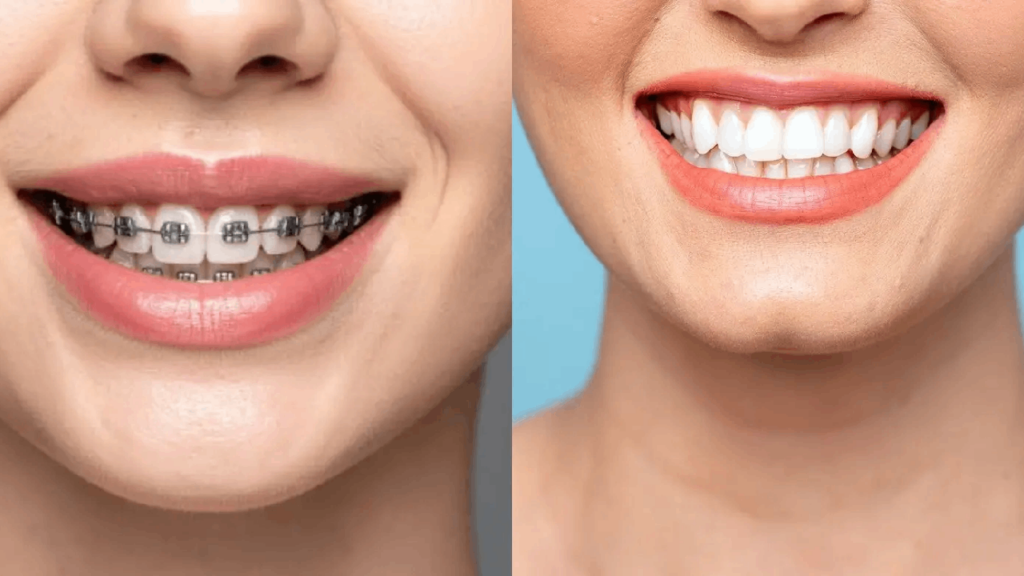
Having existing dental restorations does not necessarily mean that orthodontic treatment is not an option. In many cases, patients can undergo orthodontic treatment with crowns, bridges, or dental implants, although the treatment plan may need to be adapted according to the type and location of the restoration, the teeth that need to be moved, and the overall health of the teeth, gums, and supporting bone.
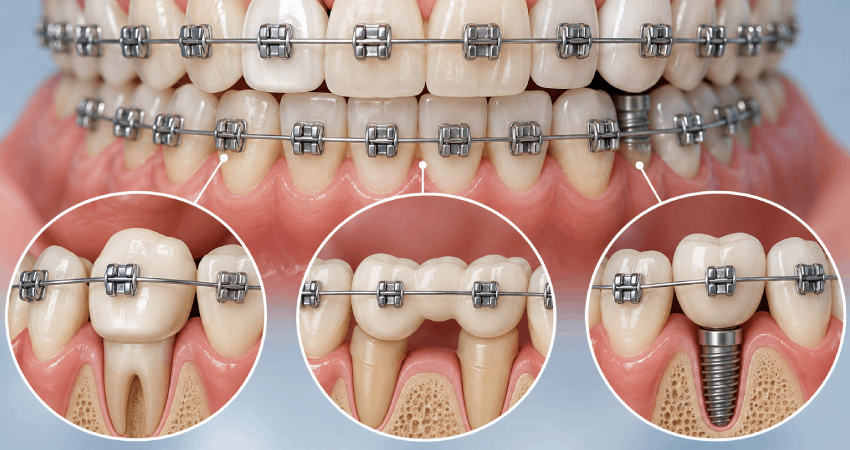
A crown placed over a natural tooth is managed differently from a dental bridge connecting several teeth. Dental implants require another approach because they are anchored directly into the jawbone and cannot move orthodontically like natural teeth.
For this reason, careful assessment and treatment planning are essential before starting braces or clear aligners when dental restorations are already present.
Table of Contents
Can You Get Braces with Existing Dental Restorations?
Yes. Many patients with crowns, bridges, or dental implants can still receive orthodontic treatment. However, existing restorations may influence how the treatment is planned and how individual teeth can be moved.
Orthodontic planning involves more than simply determining whether brackets or aligners can be placed. The orthodontist must identify which teeth need to move, how much movement is required, and whether any existing restorations may affect the desired bite and final tooth positions.
For example, a natural tooth covered by a crown may still be moved orthodontically if the tooth and its supporting tissues are healthy. A bridge connecting multiple teeth may restrict independent tooth movement, while a dental implant remains fixed in the jawbone.
This means that orthodontic treatment with existing dental restorations must be planned individually according to each patient’s dental condition.
Can Braces Be Placed on a Crown?
In many cases, braces can be used on teeth that have crowns. Although the visible portion of the tooth is covered by a restoration, the natural root and its surrounding supporting tissues remain in place. This may allow the tooth to move orthodontically when appropriate.
One important consideration is attaching an orthodontic bracket to the crown. Natural enamel and restorative materials have different surface properties, so the orthodontist may need to use specific bonding techniques or materials to achieve adequate bracket retention while minimizing the risk of damaging the restoration.
Before treatment begins, the crown itself and the underlying tooth should be evaluated. The orthodontist may also assess the gums, root, and surrounding bone to determine whether the tooth can safely undergo the planned movement.
If either the crown or the underlying tooth requires treatment, this may need to be addressed before orthodontic treatment or incorporated into the overall treatment plan.
Can You Get Braces with Zirconia Crowns?
Having zirconia crowns does not automatically prevent a patient from receiving orthodontic treatment. However, bonding orthodontic brackets to zirconia differs from bonding them directly to natural tooth enamel.
Because zirconia has different surface characteristics, the orthodontist may need to select an appropriate bonding technique to provide sufficient bracket retention while protecting the restoration as much as possible.
The decision also depends on more than the crown material. The condition of the underlying tooth, gum health, the position of the crown, and the type of orthodontic movement required must all be considered.
Therefore, braces with zirconia crowns may be possible, but the crown and supporting tooth should first be carefully assessed.
Can You Get Braces with a Dental Bridge?
Orthodontic treatment with an existing dental bridge requires careful planning because a bridge is different from a single crown.
A traditional bridge usually connects two or more teeth to replace a missing tooth. Because these teeth are linked together by the restoration, moving each supporting tooth independently may be more complicated.
Whether the bridge can remain in place during orthodontic treatment depends on its location, the number of teeth involved, the movements required, and the overall treatment goals.
In some cases, the existing bridge may not interfere significantly with the required tooth movement and can remain in place. In other cases, the orthodontic and restorative treatment may need to be coordinated, and the bridge may need to be addressed at a particular stage of treatment.
For this reason, the presence of a bridge alone does not determine whether orthodontic treatment is possible. Its position and relationship to the teeth that need to move must be evaluated first.
Can You Have Orthodontic Treatment with Dental Implants?
Yes, orthodontic treatment with dental implants can be possible, but it is important to understand the difference between a natural tooth and an implant.
Natural teeth are surrounded by tissues that allow them to move gradually through the jawbone when controlled orthodontic forces are applied. Dental implants, on the other hand, are designed to integrate directly with the bone.
Once an implant has successfully integrated with the jawbone, it does not move orthodontically like a natural tooth.
However, this does not mean that braces or clear aligners cannot be used when an implant is present. The orthodontist may still be able to move the surrounding natural teeth while incorporating the fixed position of the implant into the treatment plan.
Planning becomes particularly important when significant tooth movement is required around an existing implant because the implant itself will remain in its established position throughout orthodontic treatment.
Should You Get Braces Before or After a Dental Implant?
When a patient needs both orthodontic treatment and a dental implant, the timing of each procedure can have an important effect on the overall treatment plan.
If tooth positions or spaces need to be adjusted, orthodontic treatment may be performed before implant placement. This allows the orthodontist to move the natural teeth and create or refine the appropriate space for the missing tooth before the implant is placed.
A treatment sequence may therefore involve:
Orthodontic tooth movement → creating the appropriate space → evaluating the implant site → placing the dental implant in the planned position.
This approach can be important because once an implant has integrated with the jawbone, it cannot later be repositioned with orthodontic forces in the same way as a natural tooth.
Patients who already have dental implants may still be candidates for orthodontic treatment. In these situations, the treatment plan is designed around the implant’s existing position while moving the natural teeth where appropriate.
What Does the Orthodontist Evaluate Before Treatment?
Before starting orthodontic treatment in a patient with existing restorations, the orthodontist needs to evaluate how those restorations relate to the teeth, gums, jawbone, and bite.
The assessment may include the type and location of existing crowns, bridges, or implants, as well as their stability and overall condition. The health of the natural teeth, roots, gums, and supporting bone is also important.
The orthodontist will determine which teeth need to move, the direction and extent of movement required, the available space, and the relationship between the upper and lower teeth.
Clinical examinations and dental imaging may also be used to assess the roots, supporting bone, implant positions, and existing restorations. This helps determine whether the restorations can remain unchanged throughout treatment or whether restorative treatment should be coordinated with orthodontics.
The appropriate orthodontic method can then be selected according to the patient’s needs. Depending on the case, this may involve traditional braces or clear aligners.
The goal is to create an orthodontic plan that achieves the required tooth movement while protecting oral health and taking existing dental restorations into account.
Have Crowns, Bridges, or Implants and Considering Orthodontic Treatment?
Having a crown, bridge, or dental implant does not automatically rule out orthodontic treatment. However, existing restorations make careful assessment and treatment planning particularly important.
At Dr. Amir Zahrawi’s Clinic, the teeth, bite, and existing dental restorations can be evaluated to determine which teeth can be moved and how crowns, bridges, or implants should be incorporated into the orthodontic treatment plan.
If you already have dental restorations and are considering braces or clear aligners, book a consultation with Dr. Amir Zahrawi’s Clinic to have your case evaluated and discuss an orthodontic treatment plan tailored to your dental condition.