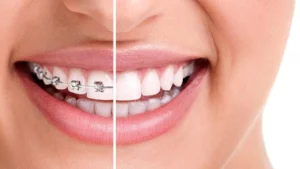

Dental midline deviation occurs when the line between the front teeth does not align with the center of the face or when the upper and lower dental midlines do not match.
A minor difference may be barely noticeable and may not require treatment. More significant deviation can affect smile symmetry or indicate an underlying issue with tooth position, missing teeth, the bite, or jaw alignment.
Table of Contents
In many cases, braces or clear aligners can improve the dental midline. However, treatment depends on whether the problem originates from the teeth, the jaws, or a combination of both.
What Is the Dental Midline and When Is It Deviated?
The dental midline is the imaginary vertical line passing between the two central front teeth.
Ideally, the upper dental midline should approximately correspond with the facial midline, while the upper and lower dental midlines should also be reasonably aligned.
Dental midline deviation occurs when:
- The dental midline shifts to the right or left of the facial center.
- The upper and lower dental midlines do not match.
- Tooth or jaw asymmetry makes one side of the smile appear different from the other.
A very small deviation of approximately 1–2 mm may not be cosmetically noticeable and does not always require treatment.
An orthodontist evaluates the amount of deviation together with the bite and facial proportions to determine whether treatment is necessary.

What Causes Dental Midline Deviation?
Several dental and skeletal factors can cause the midline to shift.
Crowding or Spacing
When there is not enough room in the dental arch, teeth may rotate or move out of position, causing the midline to shift.
Spacing can have a similar effect. Uneven gaps allow teeth to move differently on each side, particularly when a tooth has been removed and not replaced.
Missing Teeth
Losing a tooth can allow neighboring teeth to gradually move toward the empty space. If movement occurs mainly on one side, the center of the dental arch may shift.
Congenitally missing teeth can also create unequal tooth distribution and contribute to midline asymmetry.
Differences in Tooth Size or Position
Teeth do not always have identical proportions on both sides of the mouth. Differences in tooth size can affect how space is distributed.
An impacted tooth or an extra tooth may also push neighboring teeth away from their normal positions and change the dental midline.
Jaw Asymmetry
Sometimes the teeth are not the primary cause. A difference in the position of the upper or lower jaw can create an asymmetrical bite and make the dental midlines appear misaligned.
Examples include a lower jaw shifted to one side or a unilateral crossbite. These cases require careful diagnosis because moving the teeth alone may not fully correct the underlying skeletal problem.
How Is Dental Midline Deviation Diagnosed?
Diagnosing a dental midline shift involves more than looking at the front teeth.
The orthodontist evaluates the face, teeth, bite, and jaw relationship to determine whether the deviation is dental, skeletal, or a combination of both.
The assessment may include:
- Comparing the upper dental midline with the center of the face.
- Comparing the upper and lower dental midlines.
- Evaluating crowding and spacing.
- Checking for missing, impacted, or unusually positioned teeth.
- Examining the bite for crossbite or other asymmetries.
- Reviewing previous extractions, injuries, or orthodontic treatment.
Panoramic and cephalometric X-rays may be used to evaluate the teeth and jaw relationship. In selected cases, CBCT imaging provides additional three-dimensional information.
Digital scans or dental models may also help measure the deviation and plan the required tooth movement.
Can Braces Correct Dental Midline Deviation?
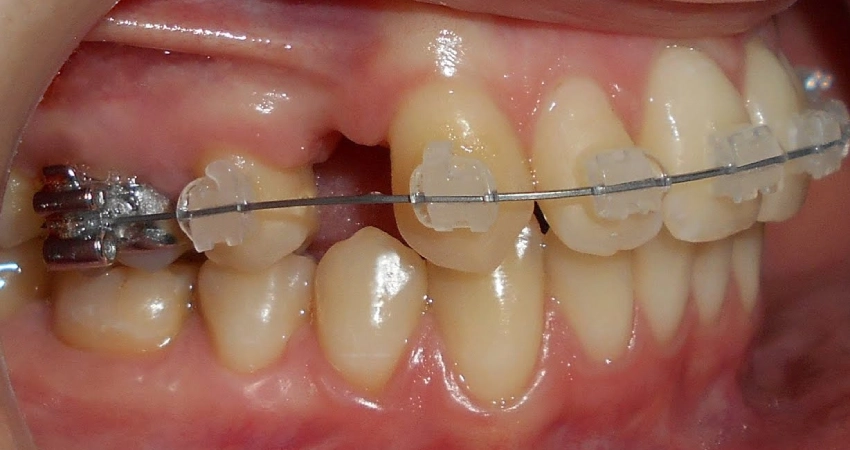
Yes. Braces can correct dental midline deviation in many cases, particularly when the problem is primarily caused by tooth position.
Orthodontic treatment can move teeth gradually to redistribute space and bring the dental midline closer to the desired position.
Depending on the case, treatment may involve:
- Moving groups of teeth toward one side.
- Closing uneven spaces.
- Creating room when crowding is present.
- Using orthodontic elastics.
- Correcting bite discrepancies.
The goal is not always to achieve mathematically perfect alignment with the center of the face. The orthodontist considers facial symmetry, bite function, and the overall appearance of the smile when determining the appropriate final position.
Can Clear Aligners Correct Dental Midline Deviation?
Yes, clear aligners can correct some dental midline deviations, especially mild to moderate cases caused mainly by tooth position.
A series of custom aligners gradually moves the teeth according to a planned sequence. They may help correct mild crowding, close spaces, and reposition the front teeth to improve midline alignment.
However, clear aligners may not be sufficient alone when there is:
- A significant midline shift.
- Severe crowding.
- Complex bite problems.
- Long-standing tooth loss that has altered the dental arch.
- Significant skeletal jaw asymmetry.
In more complex cases, fixed braces or additional orthodontic techniques may provide better control. Advanced skeletal problems may require a combined orthodontic and surgical approach.
When Is Midline Deviation Caused by the Jaw?
Distinguishing a dental problem from a jaw-related problem is important because the treatment can be very different.
A skeletal cause may be suspected when:
- The chin is visibly shifted to one side.
- One side of the face appears more prominent.
- The bite differs noticeably between the right and left sides.
- A unilateral crossbite is present.
- The jaw shifts to one side during opening or closing.
These signs do not confirm a skeletal problem on their own, but they indicate that the jaw relationship should be evaluated.
When jaw asymmetry is responsible, orthodontic treatment may improve tooth alignment and bite function but may not fully correct facial asymmetry.
In selected advanced cases, treatment may involve both orthodontics and orthognathic jaw surgery. The need for surgery is determined individually after a complete orthodontic and surgical assessment.
Does Every Dental Midline Deviation Need Treatment?
No. A dental midline does not have to be perfectly centered for a smile to look balanced.
A small deviation that does not affect the bite, dental health, or appearance may not require treatment.
Treatment becomes more relevant when the deviation:
- Is clearly visible and affects smile symmetry.
- Results from significant crowding or spacing.
- Is associated with missing teeth.
- Causes or accompanies bite problems.
- Is related to a jaw discrepancy requiring evaluation.
The decision should therefore be based on the cause and overall orthodontic condition rather than the midline measurement alone.
How Long Does Dental Midline Correction Take?
Treatment time varies according to the amount of deviation and the complexity of the underlying problem.
The original treatment guidance indicates that orthodontic treatment may generally range from approximately 6 months to 2 years.
Treatment may be shorter when the deviation is mild and the bite is already close to normal.
It may take longer when significant crowding, large spaces, complex tooth movements, or jaw discrepancies are present.
Patient cooperation also matters. Wearing aligners and orthodontic elastics as instructed and attending scheduled appointments can help treatment progress according to plan.
Restore Smile Balance With Dr. Ameer Ghiyath Al-Zahrawi
Correcting dental midline deviation begins with identifying whether the problem comes from tooth position, jaw alignment, or both.
At Dr. Ameer Ghiyath Al-Zahrawi’s clinic, the smile, bite, teeth, and jaw relationship are evaluated, with orthodontic imaging and analysis used when needed to determine the cause of the deviation.
Based on the findings, an appropriate treatment plan can be developed using fixed braces, clear aligners, or a combined approach when necessary.
If you have noticed that your dental midline does not align with the center of your face or that the upper and lower dental midlines do not match, you can schedule an orthodontic consultation to evaluate the cause and determine the appropriate treatment options.